
Will Lula make a comeback? Global imperialists and resource extractors shudder at the prospect

With the potential comeback of Lula da Silva, Brazil may once again be on a path away from fascism and one that puts economic justice and anti-imperialism first.
 
by Alan Macleod  

Part 3 - A towering figure

Despite being coy about next year, Lula is behaving as if he is already president, releasing statements urging his countryfolk to wear masks and inviting U.S. President Joe Biden to an emergency coronavirus summit on vaccine equity.

A towering figure in his homeland, the former street urchin and shoe-shine boy turned union leader was elected president in 2002 and served until 2011, leaving office with an 83% approval rating. 
 
The economy grew steadily and poverty was halved under his stewardship. While the U.S. was invading Afghanistan and Iraq, Lula declared his own domestic war — against hunger. His signature policy was the Bolsa Família package; a deal whereby mothers were given cash transfers of up to $150 per month if they enrolled their children in school and ensured they were immunized against yellow fever and other deadly diseases. An estimated 50 million people benefited from it. It was policies like these, Urban noted, that built his support among the country’s popular classes.

Lula’s impact on Brazil and on Latin America cannot be overstated. He dominated politics in both from being first elected as president in 2002, and he continues to dominate Brazilian politics,” said Dr. Barry Cannon, a sociologist from the National University of Ireland, Maynooth, who also noted that, under Lula’s rule, Brazil was “remarkably stable socially and economically.

Needing the support of liberals and more centrist forces, Lula was not as radical as many social movements that helped him into power would have liked, and did not challenge U.S. power as directly as other governments like those in Venezuela or Bolivia. But — as Steve Ellner, a retired political scientist from the Universidad de Oriente in Venezuela, explained to MintPress — activists saw his government as a “friendly” administration; one that would listen to them and certainly not repress them in the ways previous governments had done.

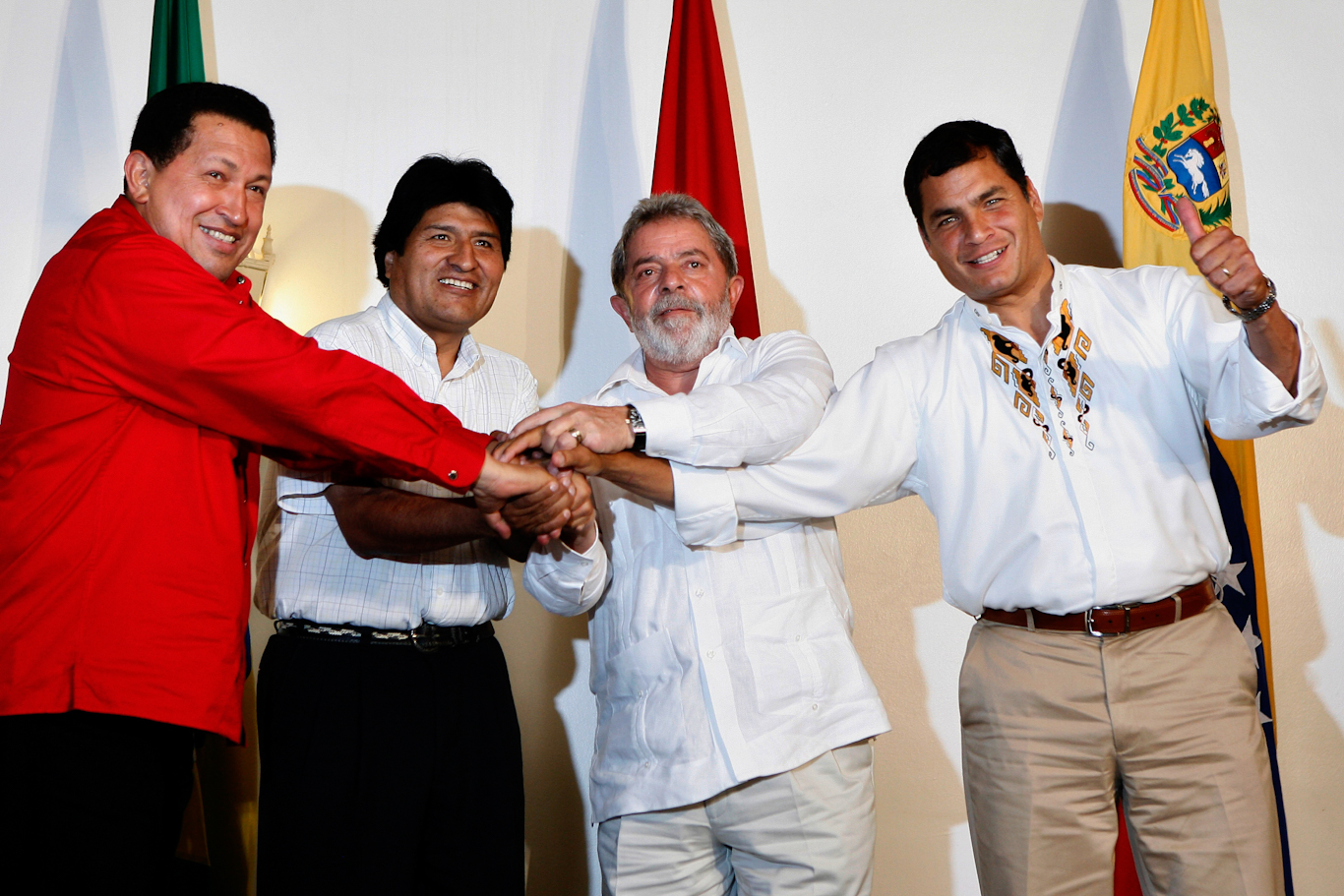
Perhaps his most important impact, however, was on international affairs. Lula was one of the leaders of the so-called “Pink Tide” — a wave of Latin American countries that began electing leftist, pro-poor, anti-imperialist governments in the 2000s. By 2011, a large majority of the region was ruled by these forces. Leaders like Venezuela’s Hugo Chavez, Bolivia’s Evo Morales and Ecuador’s Rafael Correa rankled officials in Washington by nationalizing key resources and denouncing capitalism and inequality. Lula was not as radical, but, as leader of the world’s fifth-largest country by area and population, he was arguably the most important.
Comments

Popular posts from this blog

Capitalism & Genocide - Yanis Varoufakis Speech at the Gaza Tribunal, 23rd October 2025, Istanbul

Yanis Varoufakis   On 23rd October, Yanis Varoufakis testified in front of the Jury of Conscience in the context of the Gaza Tribunal. His speech focused on the economic forces underpinning the genocide of the Palestinian people. In particular, he spoke on the manner in which capitalist dynamics have historically fuelled the white settler colonial project and, more recently, how the accumulation of a new form of capital - which he calls cloud capital - has accelerated, deepened and amplified the economic forces powering and propelling the machinery of genocide. 

Exposed: USA plans to use this country to hurt China & help Israel

Geopolitical Economy Report   In Cold War Two, the USA is pressuring countries to cut ties with China and recognize Taiwan separatists. Donald Trump blatantly meddled in Honduras' 2025 election and backed a political coup to put in power right-wing oligarch Nasry "Tito" Asfura, who strongly supports Taiwan and Israel. Ben Norton discusses US imperialism in Latin America.  

Iran’s Missiles will DESTROY US Bases & Israel if Trump Attacks

Danny Haiphong   Iran is ready for war, and its hypersonic ballistic missile system could destroy Israel & US military presence forever says Scott Ritter who joined the show to break down the consequences of Trump's march to war with Iran. The former UN Weapons Inspector does a deep dive into Iran's readiness and why it should terrify Trump & Israel together. 

Iranian Seyed M. Marandi: What REALLY happened in Iran & why U.S. wants to destroy the country

Li Jingjing 李菁菁   Track records of Western interventions tell us we need to be skeptical and cautious whenever some Western politicians and pundits claim they want to liberate people in another country and bring them democracy. Seyed Mohammad Marandi is a professor at the University of Tehran in Iran. In this episode, he told Li Jingjing what happened during the protests in Iran and how Western sanctions hurt the lives of ordinary Iranians.

Israel & CIA Behind Iran Protests To Get U.S. To Attack!

The Jimmy Dore Show    As protests in Iran have heated up, western media has actively exaggerated and selectively framed the violence by using casualty figures from U.S.- and Israel-funded NGOs — all in order to build public support for another regime-change war. Former CIA officer John Kiriakou and guest Scott Ritter claim protests were infiltrated by foreign intelligence networks and that Israel and the U.S. are using “human rights” narratives similarly to the way they were used in Iraq and Syria.   Dore and Ritter contend that Iran’s government responded to armed unrest rather than peaceful protest, while mainstream outlets ignore attacks on police and public infrastructure. They warn that propaganda, sanctions, and media coordination are laying the groundwork for a wider U.S.–Israel conflict with Iran. 

US & Israel support protests in Iran: Trump calls for regime change

Geopolitical Economy Report   The US government is openly backing the protests in Iran. An Israeli media outlet admitted foreign powers are arming Iranian rioters with weapons to try to overthrow the government. Ben Norton explains the geopolitical context and why the USA has sought regime change ever since the 1979 Iranian Revolution.   

Ο βασικός λόγος που ο Τραμπ διστάζει να χτυπήσει το Ιράν

"Μικρά και ασήμαντα" από τον Πίκο Απίκο Ο βασικός λόγος που δεν έγινε η επίθεση στο Ιράν, είναι το γεγονός ότι πρόσφατα, το Ιράν αποχώρησε από το δορυφορικό σύστημα GPS που είναι Αμερικανικό και εντάχθηκε στο Κινεζικό BeiDou. Που σημαίνει ότι οι Αμερικανοί δεν έχουν τη δυνατότητα να σαμποτάρουν τους Ιρανικούς πυραύλους.  Έτσι εξηγείται και το μεγάλο ποσοστό ευστοχίας των Ιρανικών πυραύλων στην τελευταία σύγκρουση με το Ισραήλ, μέσα στο Ισραηλινό έδαφος. Αλλά και το γεγονός ότι πριν λίγες μέρες, οι ίδιοι οι Ισραηλινοί ζήτησαν τη διαμεσολάβηση της Ρωσίας, προκειμένου να αποκλιμακωθεί η ένταση με το Ιράν, αφού Ισραηλινές εφημερίδες και αξιωματούχοι είχαν παραδεχθεί ανοιχτά την παρουσία πρακτόρων της Μοσάντ σε Ιρανικό έδαφος και τον κομβικό τους ρόλο στις πρόσφατες εξεγέρσεις. Οι Αμερικανοί επομένως γνωρίζουν ότι αυτή τη στιγμή οι Ιρανοί έχουν τη δυνατότητα να χτυπήσουν Αμερικανικές βάσεις (όπως απείλησαν ότι θα κάνουν αν ο Τραμπ κάνει πράξη τις απειλές του), χωρίς να μπορούν να ...

Jeffrey Sachs: The US is a violent regime

CGTN   Shortly after US President Donald Trump announced on social media that American forces had carried out military actions against Venezuela, President Nicolas Maduro and his wife Cilia Flores were forcibly taken to New York City to face US charges including narco-trafficking. Speaking with CGTN's Tian Wei, Columbia University professor Jeffrey Sachs warned that such actions reflect a broader pattern of militarized US foreign policy. By sidelining international law and disregarding the UN Charter, Washington is undermining the very framework meant to safeguard global peace and prevent another era of devastating wars. 

A response to misinformation on Nicaragua: it was a coup, not a ‘massacre’

There is so much misinformation in mainstream corporate media about recent events in Nicaragua that it is a pity that Mary Ellsberg’s article for Pulse has added to it with a seemingly leftish critique. Ellsberg claims that recent articles, including from this website, often “ paint a picture of the crisis in Nicaragua that is dangerously misleading. ” Unfortunately, her own article does just that. It looks at the situation entirely from the perspective of those opposing Daniel Ortega’s government while whitewashing their malevolent behavior and downplaying the levels of US support they have relied on. Her piece is an incomplete depiction of what is happening on the ground, ignoring many salient facts that have come to light and which have been outdated by recent events. The following is a brief response to Ellsberg’s main points from someone who lives in Nicaragua and has observed the situation directly and intimately: https://grayzoneproject.com/2018/08/15/a-res...

Billionaires are social distancing in super yachts as tens of millions lose jobs

Everyday, it becomes clearer: the COVID-19 pandemic is hitting poor, working, and marginalized communities the hardest. Millions of workers – especially low-wage retail, food service, hospitality, and care workers – have faced the terrible choice daily between going to work and risking their health, or staying home and risking their paychecks. Many other workers don’t even have that choice, with around 30 million people in the US filing for unemployment in the past six weeks. But billionaires don’t face these same problems. As tens of millions have lost their jobs over the past two months, billionaire wealth soared by a whopping $282 billion between March 18 and April 10, according to a new study from the Institute for Policy Studies.  And while finding enough space to wait out the pandemic is something many struggle with, billionaires have been escaping to their second (or third, or fourth) homes to ride it out in luxury – all while they position themselves to ...