It
is no coincidence that some of the world’s most ardent imperialists
are behind the cynical exploitation of one heinous murder — of
British MP Jo Cox — to enable global mass-murder as well as human
trafficking under the pretext of “ethical” and “humanitarian”
intervention.
by
Vanessa Beeley and Whitney Webb
Part
2 - Who was Jo Cox?
Prior to
her untimely and tragic death, Jo Cox was a “tireless advocate”
for the Syrian opposition following the 2011 outbreak of the Syrian
conflict, even going so far as to promote Western military
intervention to depose Syrian President Bashar al-Assad. Indeed, Cox
consistently called for the U.K. to unilaterally establish a “no
fly zone” in Syria with U.S. support and argued that the U.K.
military could achieve an “ethical solution” to the Syrian
conflict by intervening in the war in order to “compel” the
Syrian government to negotiate.
Cox was
deeply connected to the Fabian Society, the claimed representative of
“modern Labour” in the U.K. This society has certainly furthered
U.K. imperialist politics, which included the “patriotic funding of
war machines,” according to author Dr. P. Wilkinson, who analyzed
the impact of Jeremy Corbyn’s election as Labour Party leader in
2015 upon the Blairite factions within the party. While the Fabian
Society can lay claim to some good work on child poverty, as an
example, more recently it has been instrumental in the expansion of
Global Britain’s economic and military interests.
In
pursuit of U.K./NATO military intervention, Cox vocally denounced
Assad and — throughout her short career in Parliament — had
maintained that the Syrian president had “helped nurture ISIS
[Daesh] and been its main recruiting sergeant.” She had also
asserted that the Syrian government had killed seven times more
civilians than the infamous terror group and the hundreds of other
militant, extremist groups and foreign mercenaries in Syria at the
behest of their backers among NATO member states and Gulf States with
Israel as their hospital wing, treating armed militants, including
Nusra Front in Israeli medical centres.
Cox’s
precarious positioning of facts upon a mountain of misleading
information has been discredited over time, as the Syrian Arab Army
and its allies have waged a successful and authentic “war on
terror” inside Syria and on its borders. All such wild accusations
and Coxian theories have been eroded with each liberation of occupied
Syrian territory and reintegration of armed militants into Syrian
society via the Russian-brokered Amnesty and Reconciliation
agreements.
Cox
failed to pinpoint the U.K. Government’s involvement in the
bankrolling of the various extremist and terrorist factions that
invaded Syria from 2011 onwards. Armed militants, who have committed
all manner of atrocities against the Syrian people, Cox claimed to
defend. Cox, like so many regime-change promoters, had never been to
Syria. She relied upon the narratives emerging from Syria produced by
the U.K. FCO (Foreign and Commonwealth Office)-manufactured and
financed White Helmets and a number of other U.K. state-funded
entities on the ground in Syria. The U.K. Government was engineering
a shadow state inside the borders of a sovereign nation and Cox
supported this blatant violation of international law either
deliberately or unwittingly.
Despite
all evidence to the contrary, Cox claimed that Syria was not another
Iraq. This is a familiar mantra often repeated by those who support
the regime change war in Syria and one that is verifiably false. It
appears that Cox had never perused the Bush/Blair communications
revealed in the Chilcot report that demonstrated the progression from
Iraq to Iran and Syria in the U.K./U.S. drive towards hegemony in the
region. Syria was in Bush’s crosshairs, as described in a TIME
article, as far back as 2006 but this was overlooked by Cox. Tony
Blair must have been proud of the efforts made by Cox to expand
“Global Britain’s” interests inside Syria:
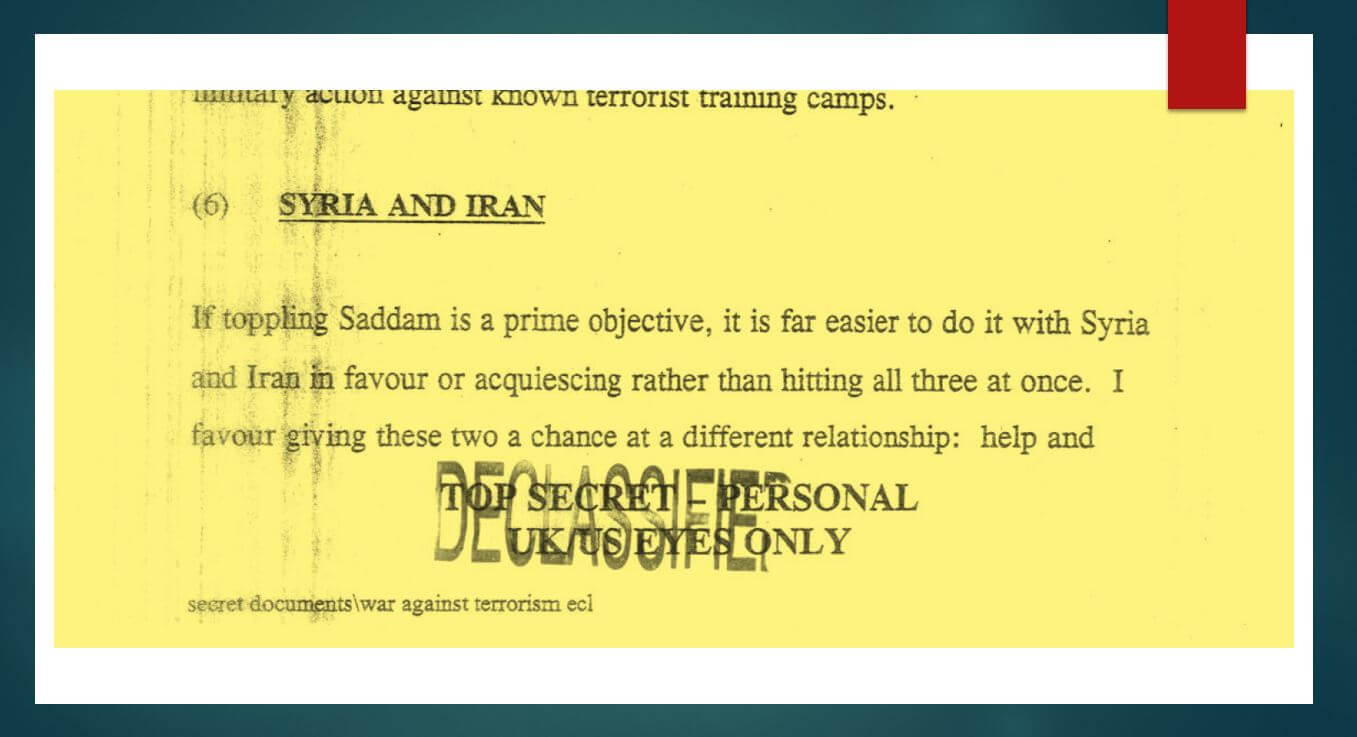
Above is
a presentation slide showing just one of the Bush/Blair communiques
as revealed by the Chilcot report. Blair suggests offering Syria and
Iran a “chance at a different relationship,” one that would be
soured by President Assad’s refusal to comply with the conditions
of that “different relationship” — conditions included favoring
the Qatar/Turkey oil pipeline preferred by the U.S. coalition. Assad
said “no,” and he said “no” to abandoning his allies in the
region or reneging on his commitment to the Palestinian cause. In
2002, Blair had even included an honorary knighthood in his early
sweeteners to persuade Assad to embrace the “different
relationship.” Blair soon changed tack when it was recognized that
Syria would not abandon its principles so easily. Plan B, which was
regime change, was put into effect.
Cox
voted against the proposed bombing of Syria in 2015, not because she
thought it was a bad idea but because she wanted David Cameron’s
government to go further and send British troops into Syria to save
the “moderates.”
In
October 2015, Cox co-wrote an article with Andrew Mitchell, former
Conservative Secretary of State for International Development
(2010-12) and Libya war-hawk. The article was published in The
Guardian, whose record on manufacturing consent for U.K. state
“humanitarian” intervention is legendary. The title said it all –
“British Forces could help achieve an ethical solution in Syria”.
Cox and
Mitchell argued that Syria was this generation’s moral test, its
“responsibility.” With little regard for the reality on the
ground in Syria, Cox and Mitchell merged the threat of international
terrorism with the perceived threat from the Syrian government and
Syrian Arab Army. The Labour and Tory MPs laser-focused on the
refugee “crisis.” No context was provided, only emotional
humanitarian flag-waving that ignored the fact that the refugee
crisis was actually caused by a far greater percentage of non-Syrian
refugees driven from Libya, Central Africa, Afghanistan and Iraq by
previous NATO “ethical interventions.” Cox and Mitchell erased
the U.K. government’s criminal record under international law with
customary virtue-signalling.
…[T]here
is nothing ethical about standing to one side when civilians are
being murdered and maimed. There was no excuse in Bosnia, nor Rwanda
and there isn’t now.
Like so
many neocons, Cox fundamentally argued that the only pathway to peace
was the removal of Assad and victory for the “rebels.” They gave
little or no consideration to the reality that this would inevitably
lead to the rise of violent sectarianism under an alleged “moderate”
Islamist governance, which would plunge Syria into the same terrorist
vacuum that Libya has been dealing with since NATO’s “ethical
solution” reduced that prosperous sovereign nation down to a failed
state.
Even
after Cox’s untimely death, her colleagues insisted that her
“legacy” should be Britain going to war in Syria. Just prior to
her death, Cox had been working on a paper entitled “The Cost of
Doing Nothing.” Posthumously this paper was completed by Tory MP
Tom Tugendhat, ex-military chair of the Foreign Affairs committee,
and Alison McGovern, a Blairite MP who was elected chair of the
all-party parliamentary group “Friends of Syria,” founded and
previously chaired by Jo Cox.
According
to a report by journalist and academic Paul Dixon, “the report
was due to be published on the day of the Chilcot inquiry on 6 July
2016, to counter growing British scepticism about foreign military
interventions.” Tugendhat, in particular, had argued (in a 2015
paper entitled “Clearing the Fog of Law”) against the
human-rights laws that, in his opinion, curtailed and restricted
British military action, he argued that “judicial imperialism
should urgently be reversed.”
In an
article written for the Telegraph, Tugendhat stated that “his
friend” Jo Cox would “never want Britain to withdraw from
the world — we must be ready to intervene.” A jingoistic
argument was deployed by Tugendhat to justify British imperialism:
“We wanted to show that Britain’s history of intervention,
military and otherwise, is common to both our political traditions
and has been an integral part of our foreign and national security
policy for over two hundred years.”
During
her life, Cox had been an advocate of war to bring peace in Syria.
Furthermore, as this article series will show, her monstrous murder
has been weaponized and politicized by the neocon war hawks in
British politics in order to further the imperialist ambitions of the
U.K. government in Syria and beyond. Significant media coverage, for
instance, has been given to Cox’s “compassion,” but little
coverage has been given to her pro-interventionist policies — which
she often promoted in apparent ignorance of reality and historical
context. The use of the “humanitarian” pretext to promote war is
hardly a new concept, but the sudden and shocking death of Jo Cox has
been exploited in order to elevate it and shield it from honest
criticism. Indeed, one could argue that to criticize Jo Cox
posthumously is akin to questioning a “Saint.” Who could find
fault with her campaign against “genocide,” her pleas for safe
havens for refugees, her apolitical stance on the world’s
“inhumanity?”
Nevertheless,
despite the possibility of being labeled insensitive and cynical, the
question that should be asked is who determines the meaning of the
terms so liberally used by Cox and her colleagues? What are the
implications of this humanitarian hyperbole for U.K. government
policy? Indeed, in the past, misplaced or even misleading
“compassion” has been used to encourage us not only to betray the
principles of international law but also to justify the escalation of
armed conflict that has brought only greater inhumanity.
In the
case of Syria, such pro-interventionist “humanitarians” have
largely promoted policies that have only deepened the suffering for
the vast majority of Syrian people. What diplomatic efforts have been
deployed? What rational, Syria-centric, political resolution has been
proposed for discussion? What respect has there been for the
self-determination of the Syrian people?
As an
example, both Cox and the White Helmets were committed advocates of a
No-Fly Zone over Syria — the White Helmets still are, of course.
Despite the very real risk of escalating tensions with Russia, which
intervened at the request of the Syrian government in September 2015,
Cox argued strongly, in 2015, for a No-Fly Zone, defying even
possible UN vetoes: “This is not about escalating a conflict
directly to take on Russia. This is about a deterrence effect to stop
the Syrian regime targeting their own civilians.”
A
“No-Fly Zone” is recognized by many acclaimed journalists and
analysts as nothing less than a “declaration of war.” Even
Hillary Clinton, neocon warhawk extraordinaire, conceded the
certainty that a No-Fly Zone would kill more Syrian civilians: “To
have a no-fly zone you have to take out all of the air defenses, many
of which are located in populated areas. So our missiles, even if
they are standoff missiles so we’re not putting our pilots at risk
— you’re going to kill a lot of Syrians.”
The
precedent of Libya stands as a horrifying example of the death and
destruction that is a consequence of such a policy, yet Cox was
willing to endorse such wholesale devastation, which would inevitably
affect more innocent lives in Syria and further fragment an already
destabilized nation. Notably, she did so by promoting
“humanitarianism,” despite the clearly inhuman consequences of
such a policy.
Furthermore,
Cox campaigned tirelessly for refugee rights. However, she did not
highlight the British Government’s role in creating the refugee
crisis in Syria by financing, promoting and equipping the “moderate”
opposition that drove civilians from their homes and into refugee
status. Neither did she highlight the British government’s role in
NATO-member-state interventions that further exacerbated the refugee
crisis in countries like Libya, Afghanistan, Iraq and Central Africa.
Beyond
the conflict itself, Syrians have endured almost eight years of
crippling economic sanctions, sanctions that were imposed by the U.K.
and its allies in the U.S. regime-change coalition. As history has
shown time and again, sanctions never damage a target government but
instead wind up punishing the innocent people who resist any kind of
foreign meddling in their sovereign affairs. These particular
sanctions have decimated the Syrian state medical sector, by
destroying hospitals and reducing the nation’s ability to treat its
population for all manner of chronic illness and to counter the
trauma of an externally waged war. Why did Jo Cox never argue that
these sanctions should be lifted, if she truly cared for the plight
of the Syrian people? Indeed, why were the solutions she supported
largely policies that — in practice — would deepen and prolong
the conflict, and why did she invoke the well-being of the Syrian
people to promote them?
Source,
links:
Comments
Post a Comment