by
Sharmine Narwani
It took
a country-wide power outage in Venezuela, whispers of a cyberattack,
and smug tweets from US officials to make me suddenly recall the
cloak-and-dagger story of a close Iranian-American friend nine years
ago.
My
friend, an engineer — who I will not name for obvious reasons
and who I will call ‘Kourosh’ for the purpose of this
article — revealed to me in 2010 that he was approached by two
“State Department employees” who offered him $250,000 to
“do something very simple” during his upcoming trip to
Tehran.
Kourosh
was freaking out because he didn’t know how these guys knew he was
going to Iran in the first place, and how they knew he was
“cash-strapped,” in the second.
He
wasn’t a particularly political person, though he had participated
in some DC protests in the aftermath of the hotly contested 2009
presidential elections. He was just one of thousands of
Iranian-American engineers in the Washington-Maryland-Virginia
technology belt looking to make a decent living.
Kourosh
told the US officials that he was not interested, that if Iran needed
to make changes, Iranians inside the country were the only ones who
should do it.
I begged
him to let me write this story, but he was very nervous and declined.
Over the next year or two, I pushed some more and he gave me further
information, but wouldn’t budge on its publication. Here’s what
he revealed:
The
State Department guys had since approached him a second time. They
offered him further details about the job. They wanted him to disable
Tehran’s power grid in exchange for the $250k. They needed someone
with technical skills, but said the job was a simple one. He would
have to go to a specific location in the Tehran area with a laptop or
similar communication device and punch in a code.
Kourosh
even told me the code. Said he had memorized it and could recite it
in his sleep. Here it is: 32-B6-B10–40-E (symbol for epsilon)
Okay,
that’s not the actual code, but it looks exactly like that — same
format, same sequence and amount of numbers and letters. I don’t
feel comfortable publishing the code in case it is still
relevant — sorry.
If
anyone knows what this code could be, please comment below. A
colleague with an engineering background has this to say about it:
“This could be a password for power grids or any equipment that
is governed by an electronic or computer system. Manufacturers have
codes they use for de-bugging or resetting a system. Control systems
are all electronic and sometimes for any reason (like an earthquake)
something is triggered and the system goes off. And then you reset it
within the vicinity of the system usually and feed in the new code.
You don’t have to physically be there if you can hack into it, but
that’s of course harder. If they (the Americans) needed to have
someone physically there during the sabotage attempt, it probably
means they didn’t have remote access to the system.”
I don’t
actually know why Kourosh received that level of detail unless he was
willing to go through with this act of sabotage on behalf of the US
government, but he assured me he would never consider it — that
he was just “curious” during the second meeting. “No
way,” he told me. “Imagine it I did it and someone’s
grandmother or father died because their life support machine
switched off.”
I
remember these details because I discussed it with a number of people
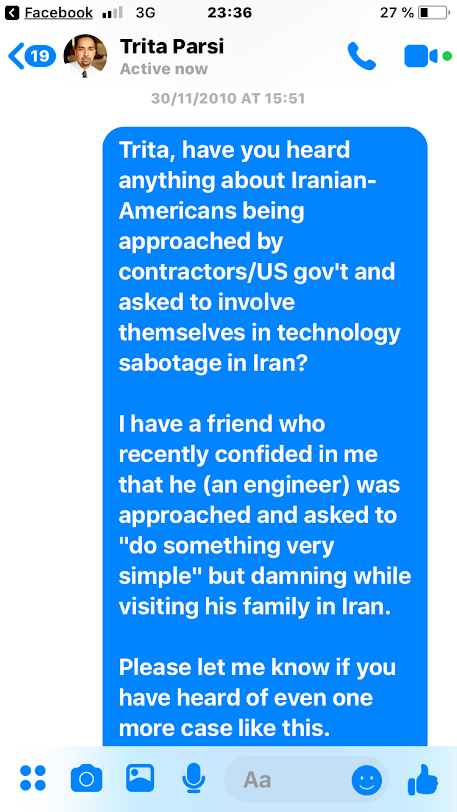
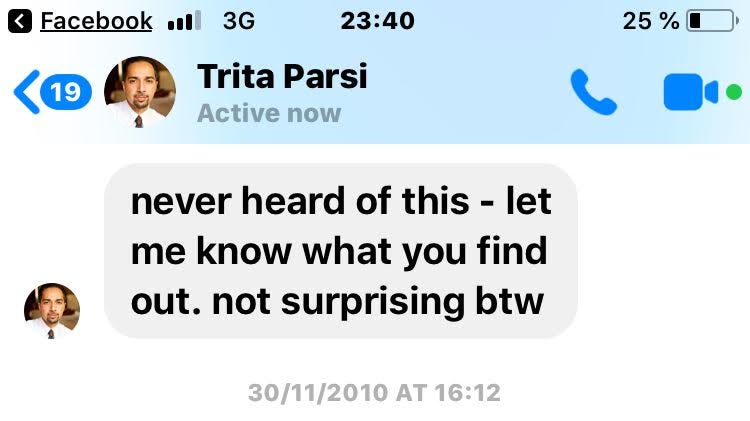
in and around 2010, without disclosing Kourosh’s name. Today, I dug
up the old Facebook message I sent to Iranian-American author and
activist Trita Parsi of the DC-based National Iranian-American
Council (NIAC), a fellow Huffington Post blogger at the time.
Trita gave me permission to post screenshots here:
Disclosure:
My Iranian-American husband and I ran an internet company in the
telecommunications industry in Washington years ago and I was a
founding member of the Iranian-American Technology Council, so I knew
a lot of engineers and technology folks from that very background.
I recall
writing to Trita precisely because he was so keyed into the political
heart of this community. It would be extremely dangerous for myself
and colleagues in my industry if the US government was recruiting
Iranian-American civilian engineers as saboteurs in third countries.
This
deep-dive by investigative journalist Whitney Webb into Venezuela’s
power outage reveals some interesting details about a Bush
administration cyberattack plan against Iran. Exposed by the New
York Times in 2016, the “Nitro Zeus” plan — which
involved the US Cyber Command — would, among other things,
target crucial parts of Iran’s electricity grid.
Take
note, however, that US officials asked Kourosh to sabotage Tehran’s
power grid during the Obama administration. Obviously aspects of the
Nitro Zeus plan remained on the table despite a switch in
government, political parties and policies.
Back
to Venezuela
It’s
been a grueling week for Venezuelans dealing with the nationwide
blackout that has brought the country to a standstill. Last Thursday
an “accident” at the Guri Dam power plant in Bolivar
state — which generates around 80% of the country’s
electricity — left at least 20 out of 23 Venezuelan states
without electricity.
As power
started to flood back to central states, a second “cyber attack”
on Saturday plunged the country back into darkness. Government
authorities have charged US officials with launching the attack on
Venezuela’s electricity infrastructure and say they will present
evidence of this to the United Nations and other international
organizations.
The US
has countered, blaming the power outage on corruption and
infrastructure neglect by the government of President Nicolás
Maduro — against whom Washington has been staging a rather
unsuccessful coup effort these past months.
But in
the midst of this to-and-fro between longtime adversaries, insightful
news reports and analysis are starting to emerge, suggesting that a
US cyberattack against Venezuela’s power grid is actually a very
possible — even likely — scenario. Says Forbes
Magazine‘s Kalev Leetaru:
“In
the case of Venezuela, the idea of a government like the United
States remotely interfering with its power grid is actually quite
realistic. Remote cyber operations rarely require a significant
ground presence, making them the ideal deniable influence operation.”
“Widespread
power and connectivity outages like the one Venezuela experienced
last week are also straight from the modern cyber playbook. Cutting
power at rush hour, ensuring maximal impact on civilian society and
plenty of mediagenic post-apocalyptic imagery, fits squarely into the
mold of a traditional influence operation,” he continues.
For
those of us who have spent years covering US irregular warfare in the
Middle East, infrastructure targets are part and parcel of these
wars — sometimes via direct strikes, other times via proxies
and sabotage operations.
I’m
not just talking about cyberattacks like the US/Israeli-made Stuxnet
virus that destroyed hundreds of centrifuges at Iranian nuclear
facilities.
In
Syria, for instance, the US military specifically targeted major
economic infrastructure under the guise of ‘fighting ISIS.’ These
include but are not limited to oilfields, wells and facilities,
electrical transformer stations, gas plants, bridges, canals, a
number of vital dams and reservoirs in the country’s northern
agricultural belt — and power generation facilities.
And
US-backed proxies — part of the Pentagon and CIA’s ‘irregular
army’ in Syria — targeted bread factories, wheat silos and
flour mills to deprive a population of basic food staples.
As
opposed to conventional wars, US irregular warfare seeks to covertly
use influence ops to turn the largest part of a country’s
population, the “uncommitted middle,” into supporting
regime-change. Destroying infrastructure, creating shortages,
unleashing political violence, propaganda dissemination — these
are all steps outlined in the US military’s Special Forces
Unconventional Warfare manual to create a disgruntled population that
will turn on its government.
And
cyber warfare is the newest theater of engagement for the Pentagon,
which is now openly ramping up its investment in “lethal cyber
weapons,” regardless of the civilian casualties these attacks will
leave in their wake.
So far
in Venezuela around 20 people are reported dead due to the blackouts,
though I’ve seen some opposition sources place that number north of
70.
Is
Venezuela’s blackout part of US cyber warfare against a Latin
American adversary? Has the US engaged in cyber warfare against
Iranian infrastructure?
Does a
duck quack?
Source,
links:
Comments
Post a Comment