
Will Lula make a comeback? Global imperialists and resource extractors shudder at the prospect

With the potential comeback of Lula da Silva, Brazil may once again be on a path away from fascism and one that puts economic justice and anti-imperialism first.
 
by Alan Macleod  

Part 3 - A towering figure

Despite being coy about next year, Lula is behaving as if he is already president, releasing statements urging his countryfolk to wear masks and inviting U.S. President Joe Biden to an emergency coronavirus summit on vaccine equity.

A towering figure in his homeland, the former street urchin and shoe-shine boy turned union leader was elected president in 2002 and served until 2011, leaving office with an 83% approval rating. 
 
The economy grew steadily and poverty was halved under his stewardship. While the U.S. was invading Afghanistan and Iraq, Lula declared his own domestic war — against hunger. His signature policy was the Bolsa Família package; a deal whereby mothers were given cash transfers of up to $150 per month if they enrolled their children in school and ensured they were immunized against yellow fever and other deadly diseases. An estimated 50 million people benefited from it. It was policies like these, Urban noted, that built his support among the country’s popular classes.

Lula’s impact on Brazil and on Latin America cannot be overstated. He dominated politics in both from being first elected as president in 2002, and he continues to dominate Brazilian politics,” said Dr. Barry Cannon, a sociologist from the National University of Ireland, Maynooth, who also noted that, under Lula’s rule, Brazil was “remarkably stable socially and economically.

Needing the support of liberals and more centrist forces, Lula was not as radical as many social movements that helped him into power would have liked, and did not challenge U.S. power as directly as other governments like those in Venezuela or Bolivia. But — as Steve Ellner, a retired political scientist from the Universidad de Oriente in Venezuela, explained to MintPress — activists saw his government as a “friendly” administration; one that would listen to them and certainly not repress them in the ways previous governments had done.

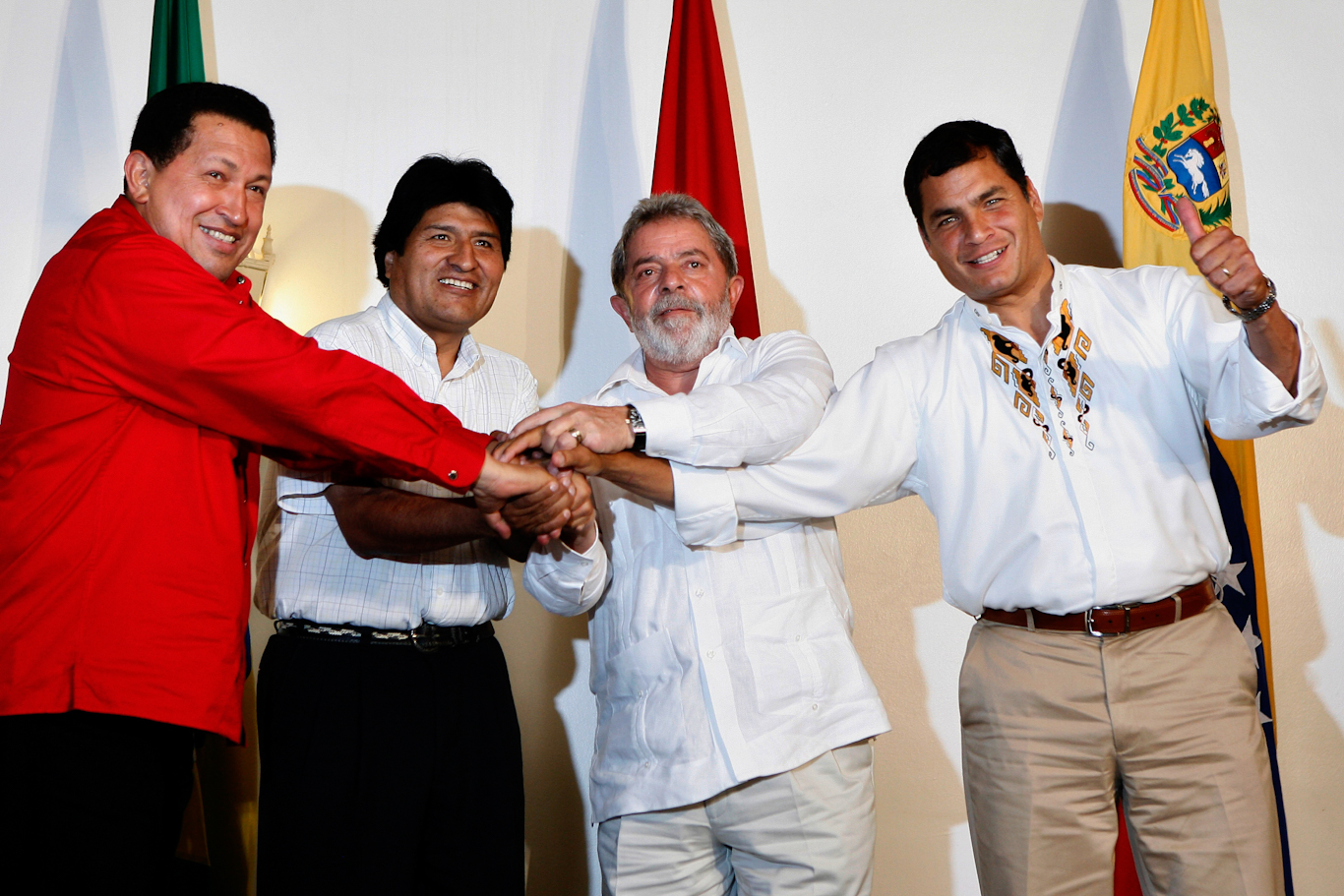
Perhaps his most important impact, however, was on international affairs. Lula was one of the leaders of the so-called “Pink Tide” — a wave of Latin American countries that began electing leftist, pro-poor, anti-imperialist governments in the 2000s. By 2011, a large majority of the region was ruled by these forces. Leaders like Venezuela’s Hugo Chavez, Bolivia’s Evo Morales and Ecuador’s Rafael Correa rankled officials in Washington by nationalizing key resources and denouncing capitalism and inequality. Lula was not as radical, but, as leader of the world’s fifth-largest country by area and population, he was arguably the most important.
Comments

Popular posts from this blog

Telegram Founder & CEO Pavel Durov Arrested in France as Online Censorship Escalates

Glenn Greenwald  

Trump PANICS As US BOMBS WEDDING & Iran GETS REVENGE!!

Secular Talk  /  Breaking Points

Netanyahu Threatens Lebanon With Genocidal Mayhem

Owen Jones   Where is the media outrage?  

Jul 2018 picks

Retired US army colonel implies that a war with Iran could start with a Vietnam-type false flag operation Corporate media begin typical operations to make progressives comply with the establishment WikiLeaks paper shows France & UK pioneers behind Libya breakup Twitter under fire on European Commission hypocrisy to 'stand with the Greek people' IMF mafia ready to repeat the big crime in Argentina The financial system of chaos: no one can tell the 'when', 'where' and ‘how’ of the next financial meltdown Standard and Poor's 'coincidentally' upgrades the Greek economy after Greece expels two Russian diplomats Jill Stein, Jeremy Corbyn, Bernie Sanders: a continuously rising political triplet proves that Socialism unites generations The idiotic circus of terror leads us to the final collapse WikiLeaks paper reveals Ecuadorian private business elites declared war on Rafael Correa right after his election and asked for US support Ho...

Όσοι περνάν των χώρα της απόγνωσης παθαίνουν αμνησία ...

globinfo freexchange Δανειστήκαμε αυτή τη φράση από ένα παλιό κομμάτι της Ελληνικής ροκ μπάντας "Τρύπες", για να περιγράψουμε με λίγα λόγια αυτό που φαίνεται να έχει πάθει η Ελληνική κοινωνία.  Πώς είναι δυνατόν μια ολόκληρη κοινωνία να έχει ξεχάσει ποιοι τη χρεοκόπησαν; Ποιοι έστησαν το άθλιο σύστημα των κρατικοδίαιτων 'ημέτερων' και της οικογενειοκρατίας; Ποιοι έσωσαν τις τράπεζες με πακτωλό δισεκατομμυρίων σε βάρος της μεσαίας τάξης; Ποιοι έκαναν τη μίζα και το ρουσφέτι επάγγελμα; Πώς είναι δυνατόν αυτή η κοινωνία να ετοιμάζεται να ξαναφέρει στην εξουσία ένα κομμάτι αυτού του άθλιου πολιτικού κατεστημένου, με την επιστροφή μάλιστα του αμετανόητα νεοφιλελεύθερου Κυριάκου Μητσοτάκη και της ομάδας του;   Η απόγνωση που έφεραν εννέα χρόνια βάρβαρων νεοφιλελεύθερων πολιτικών και σκληρής λιτότητας και που ανάγκασε τη χώρα να διαβεί τον εφιαλτικό μονόδρομο της μόνιμης χρεοκοπίας, πρέπει να έπαιξε σημαντικό ρόλο.  Διότι ως γνωστόν, η απελπισία...

Norman Finkelstein & Jeremy Corbyn: THE INTERVIEW ISRAEL WANT TO BAN

Double Down News In a powerful and deeply personal conversation, political scientist Dr. Norman Finkelstein sits down with MP and former UK Labour Leader Jeremy Corbyn to analyse the ongoing crisis in Gaza, Western diplomatic inaction, and the media's framing of the conflict. From evaluating ICJ proceedings to dismantling mainstream media "gatekeeper" tactics, Finkelstein and Corbyn provide an unsparing critique of current geopolitical realities and explain why Gaza has become a defining moral touchstone for a new generation. Beyond foreign policy, the pair explore the broader societal shifts shaping world politics today. Drawing on four decades of political activism, they compare today's student movement to historical anti-Apartheid and anti-Vietnam War struggles, while examining the decline of social mobility, the commercialisation of higher education, and the impact of digital media on critical thinking and long-term political engagement.

Houthis Have Inflicted "Astronomical" Damage On U.S. & Israel

Katie Halper Katie Halper talks to Ashok Kumar about how the Houthis are making history: "this is the first time in history that you had the maintenance of a blockade from a force with no navy," Trump "doesn't know what to do about it" and they're inflicting "astronomical liabilities" on Israel and the U.S.  Ashok Kumar is a University of London Professor and a Green Party activist in the U.K.

EXPOSED: Zohran Reveals MASSIVE 9/11 Cover Up & SHOCKS ALL!!

Secular Talk

Iran Backs Yemen's MASSIVE Attack, Missiles SLAM Saudi & US Navy

Danny Haiphong Prof. Seyed Mohammad Marandi discusses Iran's major support for Yemen's ongoing offensive against US-Saudi forces and the game changing shift in the war.

Ben Gvir, Smotrich TRAPPED In Britain? Israel in PANIC after UK STUNS World

OPTM The United Kingdom has just dropped a political bombshell that has sent shockwaves through the occupation regime. In an unprecedented move, Britain—alongside France, Canada, and nine other nations—has banned all trade in goods produced in illegal settlements in the occupied West Bank. Foreign Secretary Ed Miliband accused settler terrorists of carrying out ethnic cleansing, declaring that the UK would ban imports of all settlement goods and restrict services including financing and construction. The reaction from the occupation's far-right ministers has been nothing short of hysterical. Finance Minister Bezalel Smotrich called for the immediate expulsion of the British ambassador, while National Security Minister Itamar Ben-Gvir—in a fit of delusional whataboutism—demanded that the occupation government recognize Argentine sovereignty over the Falkland Islands and impose sanctions on Britain. Ben Gvir and Smotrich are trapped, and they know it. This is the colonial master fina...