
CIA had an agent at a newspaper in every world capital at least since 1977

Joel Whitney is a co-founder of the magazine Guernica, a magazine of global arts and politics, and has written for many publications, including the New York Times and Wall Street Journal. His book Finks: How the C.I.A. Tricked the World's Best Writers describes how the CIA contributed funds to numerous respected magazines during the Cold War, including the Paris Review, to subtly promote anti-communist views. In their conversation, Whitney tells Robert Scheer about the ties the CIA’s Congress for Cultural Freedom had with literary magazines. He talks about the CIA's attempt during the Cold War to have at least one agent in every major news organization in order to get stories killed if they were too critical or get them to run if they were favorable to the agency. And they discuss the overstatement of the immediate risks and dangers of communist regimes during the Cold War, which, initially, led many people to support the Vietnam War.


James Jesus Angleton was part of this post-OSS group that understood how important spying and covert ops had been in World War II. And from there, he makes all kinds of terrible mistakes. He and his group believed essentially that they needed to do better propaganda than the Soviets did, and one of the ways that they thought they could do it better was to do it subtly and, you could say, secretly. 
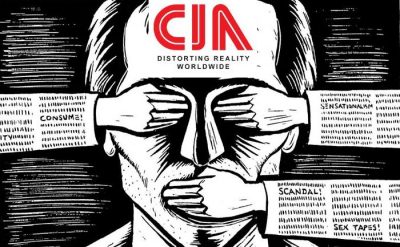
Image result for cia 
So, when this program is threatened with exposure in ‘64, ‘65, ‘66 and ‘67 through various sources like Ramparts and The New York Times, this privilege of secrecy that they enjoyed was not something that they were willing to give up. So you have something that is described as relatively benign, this funding of culture through the Congress for Cultural Freedom, a funding of student movements through the National Student Association, the funding of labor unions that would be less communist-influenced than the communist-dominated ones that they presumed were out there. These were seen as benign answers. They were reactions to Soviet penetration. So, secrecy is a key to making them work.

So, even if you want to make the argument that, for instance, the Congress for Cultural Freedom never censored its magazines–which I think has been severely disproved; they did censor. Even if you wanted to say that they published all sorts of great writers–which clearly they did; that was part of the subtlety of it and part of the brilliance of it, and part of the soft-power charm of it. Even if you wanted to say all that, when the secrecy is exposed by honest accounting in the media, the fourth estate, the adversarial media of American bragging around the world, they are so attached to their secrecy, and so upset, the CIA group led by people like Angleton, that they commit something that is about as anti-American as anything in our system. Which is: more secrecy, more media penetration to the point of penetrating, first, the anti-Vietnam War press; second, the student, the college student newspapers and press; the alternative, so-called, press. Which essentially is a license to do what they did later. So, where Ramparts was penetrated, leads to Operation Chaos, presumably; that leads to Operation Mockingbird in the seventies.

By the time we have Carl Bernstein reporting on Operation Mockingbird, and John Crewdson reporting on its international equivalent in the New York Times–Bernstein in Rolling Stone–you essentially see the CIA trying to have at least one agent at every major news and media organization it can do in the world.

And Crewdson reporting in the Times at the end of 1977 essentially says that they had one agent or contract agent at a newspaper in every world capital on Earth. They could get stories killed or get stories to run that portrayed the CIA’s views in a favorable way, or kill them if they did not.


Comments

Popular posts from this blog

“Russia & China Preparing For War With The US!”

The Jimmy Dore Show   Colonel Douglas Macgregor explains that as a result of recent military conflicts, Russia, China, and Iran have become allies, and that Beijing and Moscow have concluded that "if we let Iran fail, we're next on the menu" from what he describes as a "rogue state led by a rogue personality," meaning they will intervene to prevent Iran's collapse if the US threatens it. He tells Jimmy Dore that Putin called Trump for an hour and a half to make it clear that a military campaign in Iran would not succeed and would make the situation much worse, offering to store Iran's enriched uranium as a diplomatic gesture. Macgregor warns that if the US restarts the war, China could send 40 or 50 surface combatants and submarines to the Indian Ocean, and Russia could fly MiG-31s into Iranian airspace — not to provoke a direct confrontation but to "make a point." He concludes that the British Empire overreached and overextended with World War...

US Warships Under Fire: Iran Hits Back & Blasts UAE

MintPress News  "PROJECT FREEDOM." Trump calls it humanitarian aid. We call it what he already admitted it is: piracy. On Friday, Trump boasted that US forces seizing Iranian ships and oil were "sort of like pirates, but we are not playing games."  By Sunday, he had rebranded the blockade as "Project Freedom"—a military escort operation to guide ships through the Strait of Hormuz. Today, that operation went live: 15,000 US troops, guided-missile destroyers, and over 100 aircraft are enforcing American "freedom" at gunpoint. Let's be clear: Washington didn't enter the Strait to defend commerce. It entered to monopolize commerce—to maintain imperial control over the world's oil arteries and strangle Iran's economy.  Iran knows this. That's why closing the Strait and establishing its own transit protocols remains its strongest card in the fight for self-determination. When Trump confessed to piracy, he wasn't joking. He was c...

How 'Liberal' Media Sold You Mass Murder & Genocide

Secular Talk    

A response to misinformation on Nicaragua: it was a coup, not a ‘massacre’

There is so much misinformation in mainstream corporate media about recent events in Nicaragua that it is a pity that Mary Ellsberg’s article for Pulse has added to it with a seemingly leftish critique. Ellsberg claims that recent articles, including from this website, often “ paint a picture of the crisis in Nicaragua that is dangerously misleading. ” Unfortunately, her own article does just that. It looks at the situation entirely from the perspective of those opposing Daniel Ortega’s government while whitewashing their malevolent behavior and downplaying the levels of US support they have relied on. Her piece is an incomplete depiction of what is happening on the ground, ignoring many salient facts that have come to light and which have been outdated by recent events. The following is a brief response to Ellsberg’s main points from someone who lives in Nicaragua and has observed the situation directly and intimately: https://grayzoneproject.com/2018/08/15/a-res...

Russia & China Now OPENLY Backing Iran!

The Jimmy Dore Show    

Οι ιδιώτες 'επενδυτές' ως η μόνη επιλογή για ανάκαμψη: άλλο ένα παραμύθι του νεοφιλελέ κατεστημένου

Άλλη μια 'ιερή αγελάδα' της νεοφιλελεύθερης χούντας που κανείς δεν επιτρέπεται ούτε καν να διανοηθεί να αμφισβητήσει του system failure Το Ελληνικό πείραμα διανύει ήδη τον έβδομο χρόνο του με την οικονομία ρημαγμένη και κανένα σημάδι ανάκαμψης στον ορίζοντα. Εκτός από την απόλυτη αποτυχία των νεοφιλελεύθερων πολιτικών που επιβλήθηκαν στην Ελλάδα από την Τρόικα της καταστροφής, έχει ενδιαφέρον κανείς να εξετάσει και τον τρόπο που τα νεοφιλελεύθερα αφηγήματα έχουν επηρεάσει σε μεγάλο βαθμό την κοινή γνώμη, με αποτέλεσμα να καταλήγουν αναπόσπαστο κομμάτι ενός στρεβλού ορθολογισμού μέσα στις κοινωνίες. Η διαδικασία αυτή γίνεται με όχημα, κυρίως, την προπαγάνδα και την πλύση εγκεφάλου από τα ΜΜΕ και το πολιτικό κατεστημένο. Ένα από τα κεντρικά κλισέ των φερέφωνων του νεοφιλελευθερισμού στην Ελλάδα και αλλού αφορά την απόλυτη αναγκαιότητα των ιδιωτών 'επενδυτών' για την ανάκαμψη της οικονομίας. Τα ιδιωτικά κυρίαρχα μίντια και το πολιτικό κατεστημένο κατ...

Billionaires are social distancing in super yachts as tens of millions lose jobs

Everyday, it becomes clearer: the COVID-19 pandemic is hitting poor, working, and marginalized communities the hardest. Millions of workers – especially low-wage retail, food service, hospitality, and care workers – have faced the terrible choice daily between going to work and risking their health, or staying home and risking their paychecks. Many other workers don’t even have that choice, with around 30 million people in the US filing for unemployment in the past six weeks. But billionaires don’t face these same problems. As tens of millions have lost their jobs over the past two months, billionaire wealth soared by a whopping $282 billion between March 18 and April 10, according to a new study from the Institute for Policy Studies.  And while finding enough space to wait out the pandemic is something many struggle with, billionaires have been escaping to their second (or third, or fourth) homes to ride it out in luxury – all while they position themselves to ...

From Moscow to Beijing: Eye on good neighbors with deep people-to-people ties

CGTN   Russian President Vladimir Putin has wrapped up his state visit to China. The bilateral meeting in Beijing has led to the extension of the 25-year-long Treaty of Good-Neighborliness and Friendly Cooperation, with high political mutual trust the backbone. Meanwhile, China and Russia issued a joint statement on promoting a multipolar world and a new type of international relations. What does the China-Russia relationship seriously mean to the two countries and to the world? 

Iran’s Secret Weapon: The Undersea Cables That Could Shake the Global Economy

GVS Deep Dive   Iran’s pressure over the Strait of Hormuz may no longer be limited to oil tankers, naval routes, and energy prices. New reports suggest Tehran is considering control over undersea internet cables passing through Hormuz, potentially requiring permits, fees, Iranian law, and Iranian companies for repair and maintenance. This video breaks down why the Strait of Hormuz is not only an oil chokepoint, but also a digital chokepoint connecting Europe, the Gulf, and Asia. Beneath the waters that carry global energy flows are fiber-optic cables carrying banking data, cloud services, AI traffic, telecom networks, financial messaging, and e-commerce. If Iran turns Hormuz into a digital leverage point, the consequences could reach far beyond the Gulf. 

Zuckerberg Caught On SECRET RECORDING:Forcing Employees To Train Their AI Replacements!

The Jimmy Dore Show   Leaked audio from a Meta all-hands meeting reveals Mark Zuckerberg telling employees that the company is training AI models by having them "watch really smart people" at Meta perform tasks like coding, with the goal of dramatically improving AI capabilities—after which Meta laid off 8,000 workers via 4 a.m. emails and reassigned 7,000 more to AI-focused teams. Jimmy Dore and Americans’ Comedian Kurt Metzger note that Zuckerberg acknowledged that Meta's engineers are "significantly higher" in quality than contract workers, making them ideal training data for AI that will eventually replace them, and that Meta has committed over $100 billion to AI capital expenditures while cutting jobs. Just hours before the layoffs, Meta donated nearly a million dollars to a pro-Becerra super PAC in California, which Jimmy calls an "investment in Zuckerberg's dystopian future." The segment concludes by noting that tech layoffs have hit 138,000...